The SeRC flagship project e-Science for Cancer Prevsention and Control (eCPC) has published a position paper: “E-Science technologies in a workflow for personalized medicine using cancer screening as a case study”
ABSTRACT
Objective: We provide an e-Science perspective on the workflow from risk factor discovery and classification of disease to evaluation of personalized intervention programs. As case studies, we use personalized prostate and breast cancer screenings.
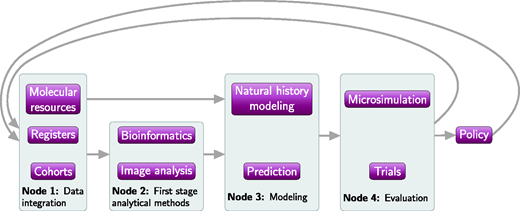
Materials and Methods: We describe an e-Science initiative in Sweden, e-Science for Cancer Prevention and Control (eCPC), which supports biomarker discovery and offers decision support for personalized intervention strategies. The generic eCPC contribution is a workflow with 4 nodes applied iteratively, and the concept of e-Science signifies systematic use of tools from the mathematical, statistical, data, and computer sciences.
Results: The eCPC workflow is illustrated through 2 case studies. For prostate cancer, an in-house personalized screening tool, the Stockholm-3 model (S3M), is presented as an alternative to prostate-specific antigen testing alone. S3M is evaluated in a trial setting and plans for rollout in the population are discussed. For breast cancer, new biomarkers based on breast density and molecular profiles are developed and the US multicenter Women Informed to Screen Depending on Measures (WISDOM) trial is referred to for evaluation. While current eCPC data management uses a traditional data warehouse model, we discuss eCPC-developed features of a coherent data integration platform.
Discussion and Conclusion: E-Science tools are a key part of an evidence-based process for personalized medicine. This paper provides a structured workflow from data and models to evaluation of new personalized intervention strategies. The importance of multidisciplinary collaboration is emphasized. Importantly, the generic concepts of the suggested eCPC workflow are transferrable to other disease domains, although each disease will require tailored solutions.
Citation:
Ola Spjuth, Andreas Karlsson, Mark Clements, Keith Humphreys, Emma Ivansson, Jim Dowling, Martin Eklund, Alexandra Jauhiainen, Kamila Czene, Henrik Grönberg, Pär Sparén, Fredrik Wiklund, Abbas Cheddad, þorgerður Pálsdóttir, Mattias Rantalainen, Linda Abrahamsson, Erwin Laure, Jan-Eric Litton, Juni Palmgren;
E-Science technologies in a workflow for personalized medicine using cancer screening as a case study.
J Am Med Inform Assoc 2017 ocx038. doi: 10.1093/jamia/ocx038
The SeRC flagship project e-Science for Cancer Prevsention and Control (eCPC) is a project aiming to support biomarker discovery and offer decision support for personalized intervention strategies.