GROMACS – cited once every 70 minutes
IMPACT CASE:
This SeRC-developed supercomputer tool provides the necessary foundation for understanding the dynamics of molecular life science.
High-performance CFD with Nek5000
IMPACT CASE:
SeRC is investing in the continuous development of the open source simulation code Nek5000 that is able to perform largest-scale turbulence simulations using the most powerful supercomputers.
Knowledge transfer in deep learning
IMPACT CASE:
Deep learning outperforms all earlier types of machine learning, especially with its capability – discovered by a SeRC researcher – to transfer knowledge from one task to another.
Learning “hard”ness
IMPACT CASE:
In this project, SeRC is developing a machine-learning approach to tailor-explore the big digitalised data of materials and accelerate the search of advanced coatings serving both the robustness and accuracy of manufacturing cutting tools.
Brain simulation
IMPACT CASE:
Unlocking the mysteries of the brain poses a lot of challenges that can only be faced by coordinated cross-disciplinary efforts including both experimental and computational science.
Cancer screening with AI
IMPACT CASE:
The Stockholm3 prostate-cancer test uses e-Science to boost efficiency, both in terms of effectiveness and costs, far beyond what traditional tests can provide. SeRC is one of the developers of the test.
Immersing the public in the scientific process
IMPACT CASE:
SeRC’s combination of hardware, methods and experts is the perfect foundation for creating new ways of presenting science to the scientists of the future. OpenSpace is a great example of this.
Climate modelling and weather prediction
IMPACT CASE:
SeRC research makes us understand the processes leading to Arctic climate change amplification and how to predict weather in Arctic conditions.
Applications open for PDC Summer School 2023: “Introduction to High Performance Computing”
14-25 August at KTH main…
Read More
Scientific Highlights
SCIENTIFIC HIGHLIGHT
Evolutionary streamlines for automatic flow feature extraction
Evolutionary algorithms find close-to-optimal solutions for tasks by imitating biologically mechanisms like selection, mutation and recombination.
SCIENTIFIC HIGHLIGHT
Feature level sets for
multi-field visualization
Iso-surfaces or level-sets provide an effective and frequently used means for feature visualization.
SCIENTIFIC HIGHLIGHT
Charge-flow network for interactive exploration of data from organic solar cell simulations
In the field of organic electronics, understanding complex material morphologies and their role in efficient charge transport in solar cells is extremely important.
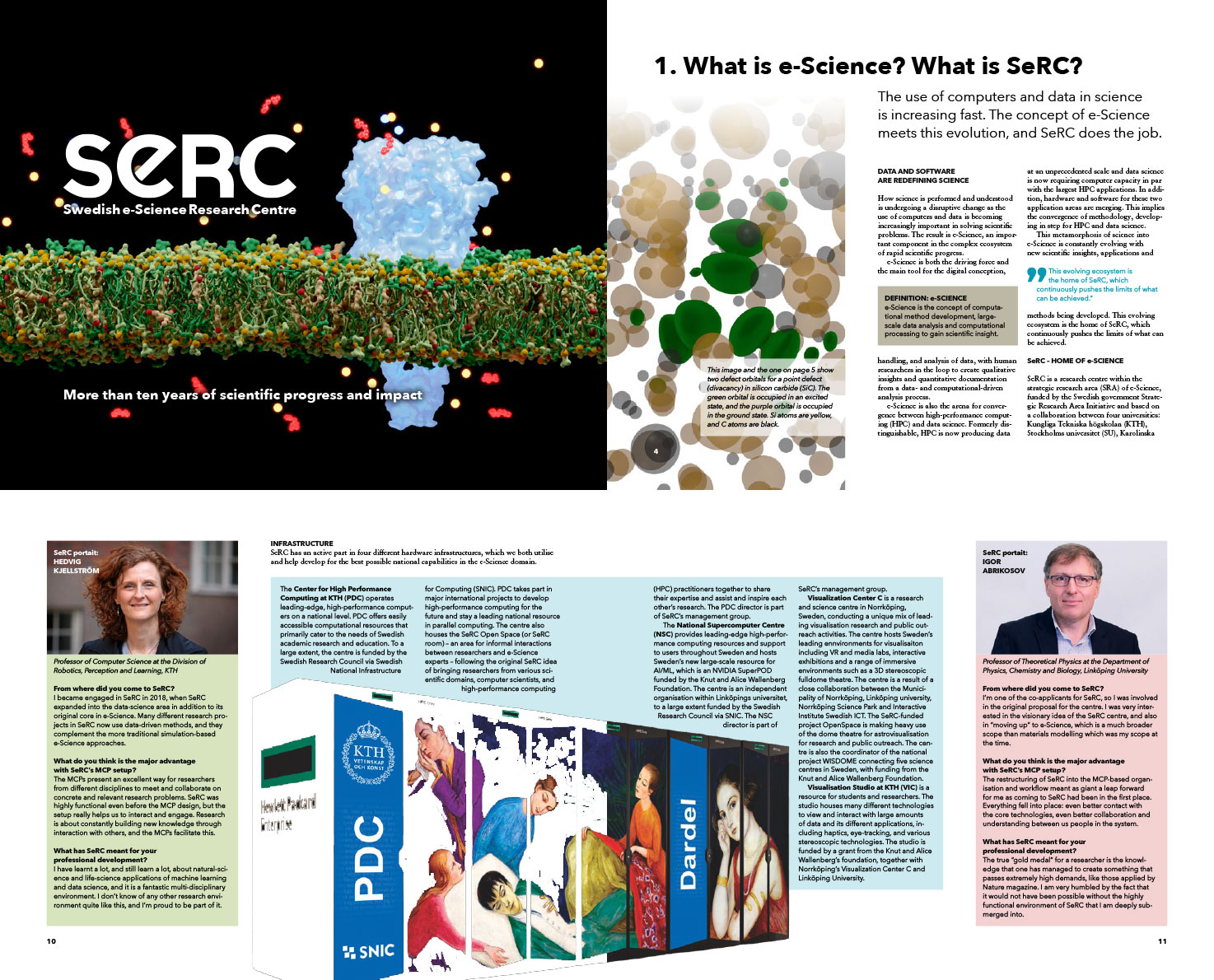
More than ten years of scientific progress and impact